How to Find Value Bets in Football — Strategy Guide for Smarter Betting
How to Find Value Bets in Football — Strategy Guide for Smarter Betting
Most bettors lose money over time. Not because they can't pick winners — plenty of recreational bettors have decent instincts about which teams are strong. The problem is that picking winners isn't enough. You can win 60% of your bets and still be down every month if you're consistently taking bad prices.
Value betting is the part most people skip. Once you understand it, the way you look at every bet changes. This is not a simple topic but it's not complicated either. It's just a way of thinking about odds that most bettors never bother to develop.
What is value bet
A value bet is when the odds a bookmaker offers are higher than the true probability of that outcome happening. That gap between the price and reality is where profit lives over time.
Simple example: flip a fair coin. The true probability of heads is 50%, which is decimal odds of 2.00. If someone offers you 2.20 on heads, take it every single time. You're being paid more than the actual probability justifies. Over a thousand flips, that 0.20 edge compounds significantly in your favour.
Football works the same way. A strong home side with a genuine 60% chance of winning should be priced at roughly 1.67. If the bookmaker has them at 1.90, that's a value bet. You're getting paid more than the probability justifies.
The catch: bookmakers employ entire teams of traders and statisticians. They don't get it wrong often. But they do get it wrong, and finding those moments consistently is what value betting is about.
Why most bettors never think about this
The average bettor backs teams they like, matches they've watched recently, names they recognise. None of that addresses the question that actually matters: are the odds right?
High-profile matches are priced with extreme precision. The Premier League title race, the Champions League final, the AFCON knockouts — bookmakers throw serious resources at getting these right because the betting volume is enormous. Finding value in the most-watched games is genuinely hard.
Value tends to show up in less-covered fixtures. Second-tier leagues in Eastern Europe. African domestic competitions. Midweek cup games with unusual line-ups. The further you go from the bookmaker's top markets, the less precise their pricing gets, and the more opportunity exists for someone who does proper homework.
How to identify value bets
Build your own probability estimate before looking at odds, Before you open the bookmaker app, form your own view of the match. What's the actual probability of a home win, a draw, an away win? Assign rough percentages. Even if they're imprecise, having an independent view before seeing the price stops you from anchoring to what the bookmaker thinks.
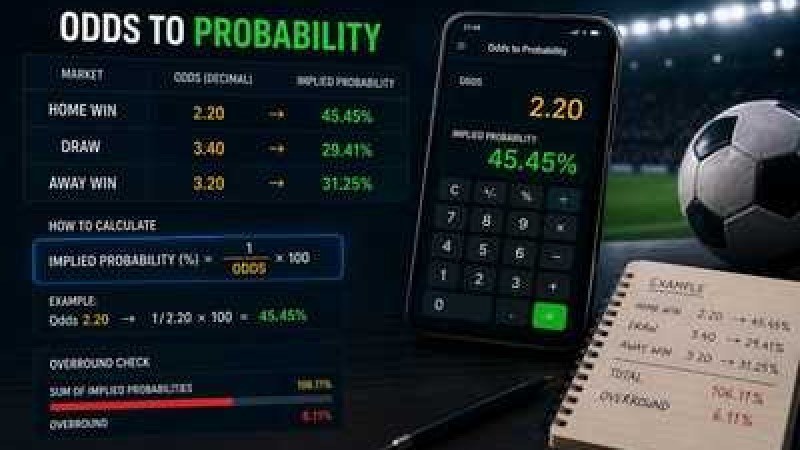
Your estimate should account for recent form (last five games is a solid window), head-to-head records at this venue, squad availability, motivation, and tactical context. You don't need a statistical model — you need a structured thought process applied consistently to every match you consider betting on. Convert your probability to fair odds Once you have a probability estimate, convert it: divide 1 by the probability. A 50% chance = 1/0.5 = 2.00. A 40% chance = 1/0.4 = 2.50. A 30% chance = 1/0.3 = 3.33.
That number is your target. If the bookmaker's price is higher than your estimate of fair odds, you have a potential value bet.
Shop the price once you identify a value selection, compare prices across bookmakers. Different platforms price the same match differently, sometimes by a significant margin. A home win might be 1.80 on Bet9ja, 1.95 on SportyBet, and 1.88 on BetKing. Always take the best available price. The difference between 1.80 and 1.95 across a month of bets adds up to real money.
Check our Bet9ja predictions today to see tips compared across platforms.
Track every bet
Value betting is a long-term strategy. Individual bets will lose. That's expected and normal. What you're trying to determine over time is whether your expectation is positive — whether the edge you think you've found is real.
You can't know that without records. Track the market, the odds, the stake, and the result for every bet. After 50 to 100 bets, patterns emerge. If you're beating the market over that sample, your process is working. If not, something in your probability estimation needs adjusting.
Where value shows up most often
Draw markets
The draw is consistently underpriced in many European leagues. Draws occur more often than odds imply, particularly in mid-table matches between evenly matched sides. If two comparable teams meet and the draw is priced at 3.40 or above in a league where draws average around 28-30%, there's often value there.
Goals markets
Over/under goals are a strong area for value betting because bookmakers price them using historical averages that can lag behind current form. A team that's conceded in 8 of their last 10 games might still be priced as an "under" game if the model hasn't caught up to what's actually happening. Check our over 2.5 goals predictions for daily analysis.
Lesser-covered leagues
The NPFL, lower African divisions, and second-tier European leagues carry more pricing uncertainty than the Premier League. Our African football predictions and NPFL predictions focus on markets where our research has a genuine information advantage over the bookmaker's pricing.
Common mistakes
High odds don't automatically mean value. A 10.00 price on an unlikely team might still be overpriced if their true probability is closer to 5%. The number alone tells you nothing. Only the gap between the number and reality matters.
Losing runs are part of value betting. Every bettor goes through periods where five or six well-reasoned selections lose in a row. The worst response is to increase stakes trying to recover. Stick to your process and your stake sizes. The edge only shows up over a large sample.
Watch out for the bookmaker margin. Most bookmakers build 4% to 8% into their odds across a full market. Even betting randomly, you'd be losing that percentage over time. To beat it, your probability estimates need to be more accurate than the bookmaker's by more than that margin. It's achievable in markets you know well. It's very hard in markets you don't.
Accumulators are mostly value traps. Combining six legs multiplies the bookmaker's margin six times. Even if each individual leg has value, the combined product often doesn't. Use accumulators for entertainment, not as a core value betting strategy. Our value bets today page focuses on singles and doubles. For accas, there's our accumulator of the day.
Building a routine that actually works
Scattered betting — whenever something looks interesting, skipping days, varying stakes randomly — produces results too noisy to learn from. You end up not knowing whether a losing period is bad luck, bad analysis, or both.
Allocate a fixed weekly bankroll. Pick your best three to five value selections per day from matches you actually know. Stake the same amount on each one (flat staking makes results far easier to read). Record every bet immediately. Review results weekly, not daily — daily variance is too high to mean anything.
Over three to six months, the picture becomes clear. If your analysis has a real edge, you'll see it. If it doesn't, you'll know what to fix.
How Sure100Predict approaches value
Our value bets today page is updated daily with selections where the odds appear higher than the true probability justifies. We don't publish every match we analyse — only the ones where the gap is clear enough to back with a recommendation.
The methodology is explained on the how we predict page. Short version: we build form models, cross-reference statistical output against match context, and compare our estimates to available prices before flagging anything as value.
Results are published on the prediction results page. If the strategy is working, it shows up there. If it's not, that shows up too. No hidden record, no cherry-picked screenshots.
Frequently asked questions about value bets
What
is
a
value
bet
in
football?
A
value
bet
is
when
the
odds
offered
are
higher
than
the
true
probability
of
that
outcome.
Find
these
consistently
and
you
profit
over
time,
even
accounting
for
the
losing
bets.
How
do
I
know
if
a
bet
has
value?
Estimate
the
probability
yourself
before
looking
at
the
odds.
Convert
it
to
fair
odds
(1
divided
by
probability).
If
the
bookmaker's
price
is
higher
than
your
estimate,
it's
potentially
a
value
bet.
Can
I
make
consistent
profit
from
value
betting?
Yes,
over
a
large
sample
with
a
disciplined
process.
Individual
sessions
will
lose.
Consistency
and
records
over
months
are
what
reveal
whether
the
edge
is
real.
Which
markets
offer
the
best
value
in
football?
Draw
markets
and
goals
markets
in
leagues
with
pricing
lag
tend
to
be
the
most
accessible.
Mainstream
markets
on
high-profile
clubs
are
heavily
monitored
and
harder
to
beat.
Are
Sure100predict
value
bets
free?
Yes.
All
tips
on
Sure100Predict
are
free
to
access.
No
subscription,
no
account
required.
How
many
value
bets
should
I
place
per
week?
Five
to
ten
well-researched
selections
is
a
manageable
and
meaningful
sample.
Betting
every
game
dilutes
the
edge
and
makes
it
impossible
to
know
what's
working.
What's
the
best
bookmaker
for
value
bets
in
Nigeria?
Compare
across
Bet9ja,
SportyBet,
and
BetKing
for
each
selection.
Price
differences
on
the
same
match
can
be
meaningful,
and
consistently
taking
the
best
available
odds
adds
up
over
time.
